Private Label Herbal Supplement Manufacturing Glossary for Brands

Starting an herbal or plant-based supplement brand often comes with excitement—and sometimes, a little confusion. Every page you scan and each quote you review from private-label manufacturers can seem jam-packed with technical language or jargon. If you’re new to clean-label, organic, plant-based supplements (whether teas, tinctures, powders, or capsules), this plain-English glossary is your friendly guide to all those terms you encounter. Use it as a resource so you can ask suppliers the right questions and move forward with clarity and confidence.
Why Manufacturing Terms Matter for Herbal Supplement Founders
Before we jump into the glossary, it’s helpful to know why understanding manufacturer language is essential. These terms do more than fill up contracts—they shape your ability to source safe, clean, high-quality herbal ingredients and navigate private-label processes smoothly. Especially if your vision centers on organic standards and transparency, being able to decode this jargon enhances your credibility as a founder and keeps your products aligned with your values.
For instance, choosing organic papaya leaf extract for your blend can assure consumers that you care about ingredient quality, while understanding clean label practices sets your offerings apart. Knowing these terms equips founders with language to shape business partnerships, select premium formats, and avoid missteps in compliance or safety.
Looking for a trusted private-label herbal manufacturing partner? Complete our Retailer & Wholesaler Interest Form to connect with the Herbal Goodness team. We'll help you explore private-label opportunities, answer your manufacturing questions, and guide you through the next steps for launching your herbal brand.
Key Manufacturing and Supply-Chain Terms To Know
Minimum Order Quantity (MOQ)
Definition: The smallest number of units or products a manufacturer will produce per run.
Why It Matters: MOQs directly impact your budget and inventory planning. Emerging brands often look for low MOQs to manage risk. For herbal supplements like capsules, teas, or tinctures, MOQs can vary widely based on production method and packaging type.
What To Ask Next: If the MOQ is higher than your needs, ask if there are pilot or sample production options—or if MOQs can be lowered for first-time orders.
GMP (Good Manufacturing Practices)
Definition: A set of regulations and guidelines that ensure products are produced consistently and controlled according to quality standards.
Why It Matters: GMP certification signals that a manufacturer is meeting rigorous standards for cleanliness, traceability, and safety. For plant-based supplements, GMP compliance is especially important to ensure the integrity of organic and vegan claims.
What To Ask Next: Request a copy of the manufacturer’s GMP certificate. Confirm which certifying body issued it and when it was last audited.
COA (Certificate of Analysis)
Definition: A document detailing the results of lab tests for a specific batch of product or ingredient, verifying identity, strength, purity, and safety.
Why It Matters: COAs protect you from uncertainties by confirming that your herbal supplement matches label claims and is free from contaminants.
What To Ask Next: Always request a COA for each batch. Ask who performed the tests (in-house or third-party lab) and which standards were used for analytical methods.
Extract Ratio
Definition: Expressed as numbers like 10:1 or 20:1, this ratio shows how much raw material (herb) is used to make a given amount of extract.
Why It Matters: A higher ratio doesn’t always mean more potency—it means more raw plant was used to achieve a given final weight or volume. Clarity about extract ratios helps you compare products and communicate potency to your customers.
What To Ask Next: Clarify if the extract ratio is based on the dried, fresh, or raw form of the plant, and whether the process preserves the bioactive compounds your brand values. For example, Soursop Leaf Graviola Extract 15X Liquid | Organic Cell & Immunity features a concentrated ratio to deliver potent wellness benefits.
Lead Time
Definition: The estimated time between placing your order and receiving your finished goods.
Why It Matters: Lead time affects product launches, restocks, and cash flow. Herbal manufacturing lead times can range from a couple of weeks to several months depending on ingredient sourcing, testing, and batch size.
What To Ask Next: Inquire if lead times are impacted by specific herbs (especially rare or seasonal botanicals), and ask about options for rush or expedited production if timelines are tight.
Allergens
Definition: Substances that can provoke allergic reactions in sensitive individuals (e.g., nuts, gluten, soy, dairy).
Why It Matters: Cross-contamination is a concern even if your herbal supplement contains only plant-based ingredients. Manufacturers should clearly state their allergen-handling protocols to ensure your product meets clean-label or allergen-free claims.
What To Ask Next: Request a copy of the allergen policy. Confirm if shared equipment is used and, if so, how thorough the cleaning processes are between productions.
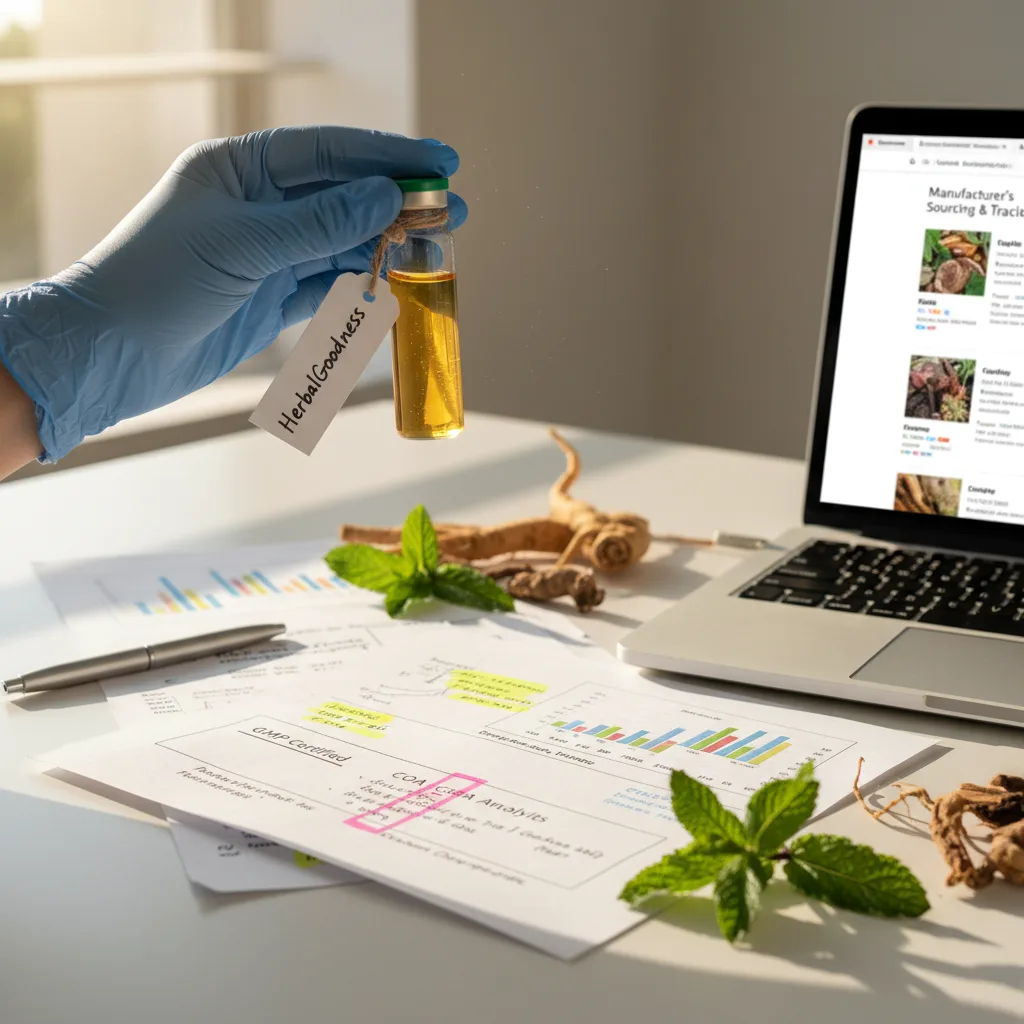
Organic Certification
Definition: A verification (often through USDA or similar organizations) that ingredients and processes meet strict organic farming and processing criteria.
Why It Matters: For mindful herbal brands, organic certification signals quality and accountability. It covers everything from how plants are grown to how they’re processed and handled. Choosing a liquid extract with organic certification emphasizes a commitment to excellence in every step.
What To Ask Next: Ask for copies of the most recent organic certificate and which specific ingredients are covered. Clarify if packaging or processing steps remain compliant.
Co-Packing
Definition: A manufacturer packs your product into retail-ready formats, such as sachets, bottles, pouches, or capsules, under your brand’s label.
Why It Matters: Co-packing streamlines the process of getting your herbal supplement from bulk to shelf-ready. It can reduce overhead but requires clear specification. Brands may choose bulk herbs for teas or finished capsules for varied retail strategies.
What To Ask Next: Check which packaging options are available (glass, recycled, compostable), and whether custom labeling or unique pack sizes can be accommodated.
Clean Label
Definition: An approach emphasizing transparent, recognizable ingredients, without artificial additives or unnecessary fillers.
Why It Matters: Clean label practices build trust with ingredient-aware customers and can differentiate your product in a crowded supplement market. The 15 Day Detox Capsules are an example of a formulation designed for purity and transparency.
What To Ask Next: Request the complete ingredient spec sheet. Ask how potential trace or incidental additives are addressed and verified on the production floor.

Ingredient Traceability
Definition: The ability to track every ingredient in your herbal supplement all the way back to its original source or farm.
Why It Matters: Traceability supports transparency and safeguards against accidental contamination or product mislabeling. This is especially relevant for blends, like organic herbal tea or functional capsules, ensuring all botanical components meet high standards.
What To Ask Next: Ask about the full traceability system, including batch numbers, origin reports, and handling documentation.
White Label vs. Private Label
Definition:
- White Label: Manufacturer creates a standard formula that many retailers can rebrand as their own.
- Private Label: Manufacturer makes a formula exclusive to your brand, often with ingredient or packaging customization.
Why It Matters: The choice shapes your product’s uniqueness and how much creative control you have over ingredient quality, organic status, and formulation tweaks. Opting for a custom papaya supplement highlights your commitment to exclusivity and integrity.
What To Ask Next: Ask about minimum customization levels, timelines for custom formulas, and intellectual property considerations.
Bulk vs. Finished Goods
Definition:
- Bulk: Unpackaged herbal powder, extract, or capsules, often supplied in large containers or bags.
- Finished Goods: Final, packaged product ready for retail sale under your branded label.
Why It Matters: Costs, logistics, and shelf-life can differ significantly between these options. New brands may choose bulk for easier R&D, or finished goods for immediate store-ready inventory.
What To Ask Next: Clarify shipping, packaging, shelf-life, and minimums for each format.
Packaging Format
Definition: The physical container or material used for the final product—glass bottles, plastic jars, compostable pouches, sachets, etc.
Why It Matters: The right packaging maintains the integrity of plant-based supplements (protecting from light, oxygen, or moisture) and supports your brand’s sustainable values. For example, Bamboo Leaf Tea 24 Bags uses optimal packaging for freshness and convenience.
What To Ask Next: Ask about packaging compatibility with specific herbal formats. For example, teas may require sealed sachets, while liquid extracts might need amber glass dropper bottles.
Shelf Life
Definition: The period during which your herbal supplement remains fresh and stable when stored as directed.
Why It Matters: Shelf life guides production planning, labeling, and customer experience. It’s especially important for organic and minimally processed formats, which may be more sensitive to heat or moisture.
What To Ask Next: Ask how shelf life is tested, and whether the use of desiccant packs, refrigeration, or specific packaging formats can extend it.
Third-Party Testing
Definition: Laboratory analysis done by independent labs (not owned by the manufacturer) to confirm product quality, potency, and safety claims.
Why It Matters: Third-party testing adds credibility to your clean and organic claims, reassuring both you and your customers. Products such as Soursop Bitters 15X Liquid Extract incorporate this principle to deliver trusted, lab-verified wellness.
What To Ask Next: Request third-party certificates or reports, and ask about test frequency and published results policies.
Fillers and Excipients
Definition: Inactive ingredients used during manufacturing to aid processing or improve shelf stability; may include flow agents, binders, or anti-caking substances.
Why It Matters: Clean-label and organic herbal supplement brands often avoid or limit certain excipients. Knowing which, if any, are used helps you maintain ingredient transparency—for example, keeping the formula of Papaya Seed Powder Capsules 60ct simple and honest.
What To Ask Next: Ask for a full list of all non-active ingredients—especially for capsules, tablets, or powders.

Non-GMO
Definition: Confirms that ingredients have not been genetically modified at any stage of production.
Why It Matters: Many natural and herbal brands prioritize Non-GMO verification as part of their commitment to traditional, plant-based sources. Options such as Bamboo Silica + Biotin Hair Growth Extract | 15X Liquid often feature Non-GMO certification as part of their label claim.
What To Ask Next: Ask which ingredients are Non-GMO verified and about supporting documentation or third-party certifications.
How to Keep Your Glossary Relevant
Herbal supplement manufacturing evolves quickly with shifts in organic standards, packaging innovation, and changing regulations. Bookmark this glossary and update your knowledge regularly—new terms or requirements may emerge as sourcing, supply chain, or labeling protocols evolve. Whenever you see a term you don’t recognize in quotes or contracts, return to this guide and get in the habit of pressing suppliers for plain-English explanations.
By building fluency in private-label manufacturing jargon, you’ll empower yourself to advocate for quality, transparency, and the clean, plant-based values that define your brand. This foundational knowledge supports smarter questions, more informed supplier relationships, and ultimately a stronger herbal product line that resonates with conscious consumers.
Frequently Asked Questions
Question 1: Why are MOQs important when launching an herbal supplement brand?
Answer: Minimum Order Quantities impact your startup costs and risk management. Brands using lower MOQs for products such as Papaya Leaf Extract 10X Capsules 600mg | Platelet & Digestive Aid can launch more efficiently and test demand before scaling.
Question 2: How do I verify a manufacturer’s organic certification?
Answer: Request the latest organic certification and confirm ingredients, like those in Organic Papaya Seed Extract 15X Liquid, are covered.
Question 3: What does 'clean label' mean for herbal supplements?
Answer: A clean label means transparency about all ingredients—nothing artificial or unnecessary. For example, the 15 Day Detox Capsules are formulated without hidden additives.
Question 4: How important is third-party testing for supplements?
Answer: Third-party testing ensures products like Soursop Bitters 15X Liquid Extract are safe, accurately labeled, and of high quality.
Question 5: What’s the difference between bulk and finished goods for herbal brands?
Answer: Bulk refers to unpackaged ingredients for custom blending, such as Raw Sea Moss 8oz Bag | St. Lucia Wildcrafted. Finished goods are shelf-ready, branded products.
Question 6: How do I ensure ingredient traceability with my products?
Answer: Choose manufacturers offering robust documentation. Traceability for products like organic herbal tea should include batch numbers and sourcing records.
Question 7: Are all herbal supplements Non-GMO?
Answer: Not all are Non-GMO. Look for clear verification, especially when choosing products such as Bamboo Silica + Biotin Hair Growth Extract | 15X Liquid.
Explore manufacturer terms with confidence as you develop your plant-based supplement line. Use this glossary as your go-to reference when evaluating partners for clean, organic, or private-label herbal formats.
About the Author
Herbal Goodness Editorial Team
The Herbal Goodness Editorial Team specializes in holistic health and superfoods, blending science and nature to educate and empower our community.
References
Smart Ways to Buy Guayusa Tea Online: Checklist for Quality, Freshness
Spotting Mislabelled Gymnema Tea: Botanical Names and Smart Search Terms
The Ultimate Rooibos Tasting Kit: What to Buy and Why
Traceability 101 for Bulk Herbal Teas: Questions to Ask Your Wholesale Tea Supplier
What Affects Wholesale Pricing for Bulk Herbal Capsules? Packaging & Fulfilment
What to Ask Before Buying a Liver-Support 'Detox' Kit: Practical Shopper's Checklist
What to Check Before Buying Cheap Bulk Organic Herbal Tea
What “Custom” Really Means When Buying an Herbal Tea Trio Online